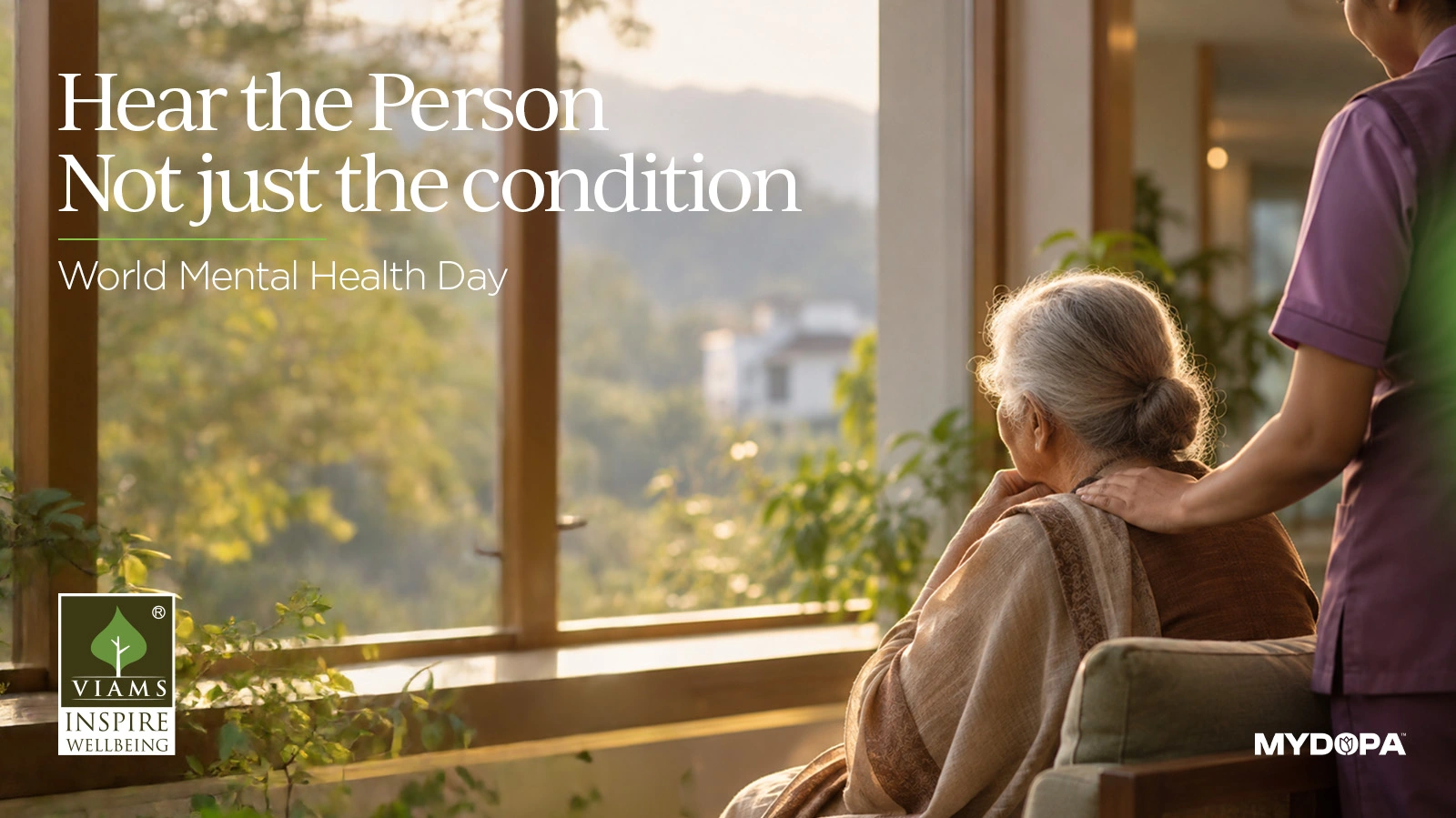

World Mental Health Day 2026 – 10 October
Mental health is an important part of healthy ageing. As people grow older, changes in physical health, mobility, memory, independence and social relationships can affect emotional well-being. For families caring for a parent with Parkinson’s disease or dementia, these challenges can become even more complex.
This World Mental Health Day 2026, we are reminded that mental health care must begin by listening to the person—not simply treating the diagnosis.
The World Health Organization’s 2026 theme is “Lived experiences heard: real voices, real change.” The campaign emphasizes the importance of involving people with lived experience in shaping mental-health services and making care more person-centred.
For senior citizens and their families, this message has particular importance. A parent living with Parkinson’s disease, dementia or another neurodegenerative condition is more than a medical diagnosis. Their fears, experiences, preferences, strengths and goals matter.
Ageing itself is not a mental illness. However, older adults may experience several circumstances that can influence mental well-being.
These may include:
Mental health and physical health are closely connected. When emotional well being deteriorates, motivation, physical activity, sleep, nutrition and participation in rehabilitation may also be affected.
This is particularly relevant when caring for parents with Parkinson’s disease or dementia.
Parkinson’s disease is commonly recognized by symptoms such as tremor, stiffness, slowness of movement and changes in walking.
However, Parkinson’s can also affect areas that are less visible. A person may experience:
These experiences can affect the person’s quality of life as much as physical symptoms.
Therefore, Parkinson’s care should not focus only on movement.
The person behind the symptoms must remain at the centre of treatment.
Dementia can gradually affect memory, thinking, communication and everyday functioning. As the condition progresses, a person may find it difficult to express their needs clearly.
This can sometimes lead families to focus entirely on what the person can no longer do.
Instead, it is important to ask ourselves, not to patient:
What can they still do?
What do they enjoy?
What makes them comfortable?
What causes fear or frustration?
What helps them feel secure?
Listening to these experiences can help families and healthcare professionals create care that is more respectful, compassionate and individualized.
WHO’s 2026 campaign specifically highlights lived experience as a form of expertise that can help make mental-health services more relevant and responsive.
When a parent develops Parkinson’s disease or dementia, the entire family is affected.
A son or daughter may gradually take responsibility for:
This transition can be emotionally difficult.
Children may experience worry, frustration, guilt or helplessness. Caregivers may also become so focused on the patient’s needs that they neglect their own emotional well-being.
Parent care should therefore include caregiver care.
A healthy caregiving environment is one in which both the patient and caregiver receive appropriate support.
For Parkinson’s disease, dementia and other neurodegenerative conditions, care should not be restricted to a single symptom or a single department.
An integrated approach can bring together different areas of support according to the individual’s needs.
1.Medical assessment
Regular clinical assessment helps identify changes in neurological symptoms, cognition, sleep, mood, medications and overall health.
2.Psychological support
Counselling and psychological support can help patients and caregivers understand emotional changes, develop coping strategies and communicate concerns.
3.Physiotherapy
Maintaining mobility, balance, strength and functional independence can positively influence confidence and participation in daily life.
4.Speech and communication support
Speech and swallowing difficulties can affect communication, nutrition and social interaction. Appropriate assessment and therapy can help maintain participation and safety.
5.Occupational therapy
Occupational therapy focuses on helping individuals perform everyday activities as independently and safely as possible.
6.Yoga and mind-body practices
Appropriately supervised relaxation, breathing and yoga-based practices may support physical activity, relaxation and overall well-being as part of a broader care programme.
7.Nutrition and lifestyle support
Adequate nutrition, hydration, physical activity and healthy routines are important components of healthy ageing and neurological rehabilitation.
8.Family and caregiver education
Families need to understand the condition, expected changes and practical ways to support the person without unnecessarily taking away their independence.
Neurodegenerative diseases are complex. Their effects can involve movement, cognition, sleep, communication, emotional health, nutrition and daily functioning.
For this reason, treatment should look at the whole person rather than a single symptom.
At VIAMS, an integrative approach to neurological rehabilitation brings together appropriate medical guidance, Ayurveda-based care and allied healthcare support such as physiotherapy, psychology, speech and communication support, occupational therapy, dietetics and yoga.
The objective is not simply to manage a symptom.
It is to help the individual maintain function, dignity, participation and quality of life for as long as possible.
Ayurveda traditionally views health through a broader balance of physical, mental and behavioural factors. When used responsibly alongside appropriate
medical assessment and rehabilitation, Ayurveda may form part of an individualized supportive-care strategy.
Importantly, integrative care should complement—not replace—necessary neurological evaluation, prescribed treatment and evidence-based medical care.
1.Listen before giving advice
Sometimes an older parent does not immediately need a solution. They may simply need someone to listen.
Ask:
“How are you feeling today?”
Then give them time to answer.
2.Encourage meaningful activity
Encourage activities that match the person’s abilities and interests—walking, music, reading, gardening, social interaction, prayer, hobbies or spending time with family.
The objective is participation, not performance.
3.Maintain a daily routine
A predictable routine can provide a sense of security, particularly for older adults experiencing cognitive difficulties.
Regular sleep, meals, medication, exercise and social interaction can create structure.
4.Don’t ignore changes in behaviour
A sudden change in mood, sleep, communication, motivation, confusion or behaviour should not simply be dismissed as “old age.”
Discuss significant or persistent changes with a qualified healthcare professional.
5.Preserve independence
Helping does not mean doing everything for the person.
Where safe and appropriate, allow parents to participate in dressing, eating, walking, household activities and decision-making.
Independence can support confidence and dignity.
6.Give caregivers permission to seek help
Caregiving is demanding.
Families should not wait until they are exhausted before seeking professional guidance.
7.Include the patient’s voice
The most important question may be:
“What matters most to you?”
That simple question reflects the spirit of World Mental Health Day 2026.
Myth 1: “Feeling depressed is a normal part of ageing.”
Reality: Emotional distress should not automatically be considered a normal consequence of ageing. Persistent changes deserve attention.
Myth 2: “Parkinson’s is only a movement disorder.”
Reality: Parkinson’s can involve non-motor symptoms affecting sleep, mood, cognition, communication and quality of life.
Myth 3: “People with dementia cannot express their preferences.”
Reality: Many people with dementia can continue to communicate preferences and participate in decisions, depending on the stage and circumstances.
Myth 4: “Caregivers should manage everything themselves.”
Reality: Professional guidance, rehabilitation and family support can make caregiving more sustainable.
Myth 5: “Mental health is separate from neurological health.”
Reality: Brain health, neurological health, physical function and emotional well-being are closely interconnected.
If your mother or father is living with Parkinson’s disease, dementia or another neurological condition, remember that care is more than medication and appointments.
Sit with them.
Listen to them.
Encourage them.
Give them opportunities to participate.
Respect their choices.
And seek help when the responsibility becomes difficult to manage alone.
Your parent may not always remember every conversation or every treatment. But the feeling of being respected, heard and cared for remains deeply meaningful.
Your diagnosis does not define who you are.
Parkinson’s disease or dementia may change certain aspects of life, but your experiences, relationships, memories, preferences and dignity remain important.
Your voice matters.
Your concerns matter.
Your goals matter.
And your healthcare should take these into account.
1.When is World Mental Health Day 2026?
World Mental Health Day is observed on 10 October 2026. The WHO theme for 2026 is “Lived experiences heard: real voices, real change.”
2.Why is mental health important for senior citizens?
Mental well-being influences motivation, social participation, sleep, physical activity, independence and overall quality of life. Supporting mental health is therefore an important part of healthy ageing.
3.Can Parkinson’s disease affect mental health?
Yes. Parkinson’s disease can be associated with non-motor symptoms such as anxiety, low mood, sleep disturbances and cognitive changes. These should be discussed with the treating healthcare team.
4.How can I support my parent with dementia?
Listen patiently, maintain familiar routines, encourage appropriate activities, support independence and seek professional guidance when behavioural, emotional or cognitive changes become difficult to manage.
5.Should caregivers also receive mental-health support?
Yes. Caregiver well-being is an important part of sustainable long-term care. Families should seek appropriate support when caregiving becomes emotionally or physically overwhelming.
6.What does integrated care mean for Parkinson’s disease?
Integrated care means addressing multiple dimensions of the person’s health rather than focusing only on one symptom. Depending on individual needs, this may involve neurological care, rehabilitation, psychological support, physiotherapy, speech therapy, occupational therapy, nutrition and appropriate complementary approaches.
7.Can Ayurveda be part of neurological care?
Ayurveda may be incorporated as part of an individualized integrative-care programme when appropriately assessed and coordinated with necessary medical and rehabilitation care. It should not be considered a substitute for essential medical treatment.
World Mental Health Day 2026 gives us an important opportunity to rethink how we care for older adults and people living with Parkinson’s disease, dementia and other neurodegenerative conditions.
The message is simple:
Listen to the person. Understand their experience. Involve them in their care.
For families, especially sons and daughters caring for ageing parents, this approach can transform healthcare from simply managing disease to supporting the person’s dignity, independence and quality of life.
At VIAMS, we believe neurological care should consider the whole person— physical health, mental well-being, function, family and quality of life. An integrated approach can bring together appropriate medical care, Ayurveda based support and rehabilitation services based on the individual’s needs.
If you are concerned about the physical, cognitive or emotional well-being of a parent with Parkinson’s disease, dementia or another neurological condition, seeking professional guidance early can help the family understand the available options and plan care more effectively.
Need expert guidance? Connect with VIAMS to get personalized support for your medical career journey.