Parkinson’s disease is commonly defined by clinical terms such as degeneration, progression, and symptom management. However, for those living with the condition, it is a deeply personal journey that affects movement, speech, emotional well-being, and independence.
When exploring effective Parkinson’s disease treatment, many patients look beyond conventional methods to find a more holistic and sustainable solution. This case study highlights how an integrative approach combining Ayurveda and rehabilitation can significantly improve quality of life.
Parkinson’s disease is a progressive neurological disorder that impacts both motor and non-motor functions. Common symptoms include:
While conventional medications help manage symptoms, they may not fully address the broader functional challenges associated with the disease.
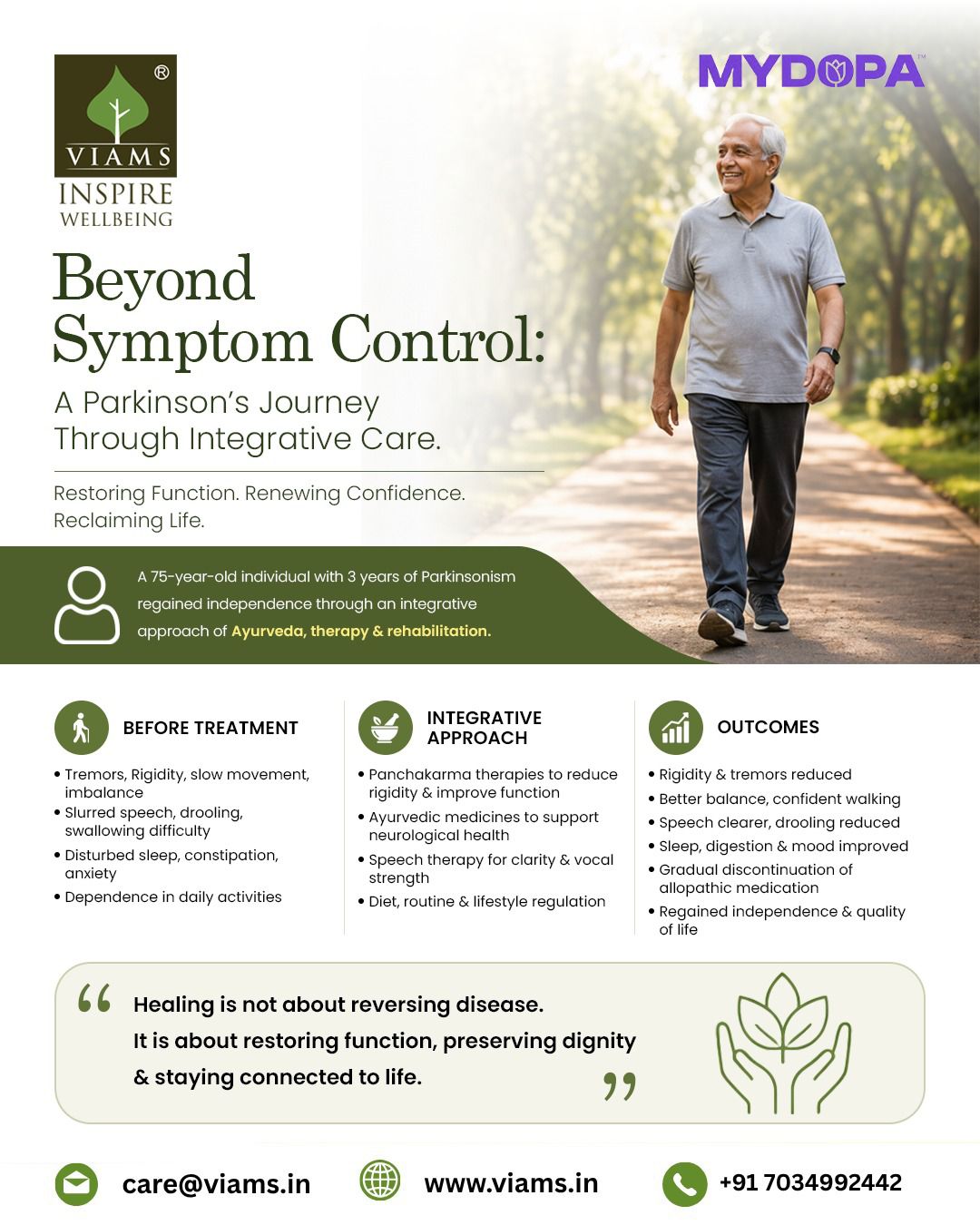
A 75-year-old male with a three-year history of Parkinsonism sought advanced Parkinson’s disease treatment after limited results from conventional medication.
He had been taking Syndopa Plus and managing diabetes with medication. Over time, his condition worsened, affecting his ability to:
This decline led to reduced independence and confidence.
These symptoms significantly impacted the patient’s overall quality of life.
Although medications like Syndopa Plus initially provided relief, their effectiveness plateaued over time.
Persistent challenges included:
This reflects a key limitation of conventional Parkinson’s disease treatment—it often focuses on symptom control rather than improving overall function and quality of life.
An integrative care model was introduced, focusing on restoring balance and improving functional capacity through Ayurveda and rehabilitation.
Benefits: Reduced rigidity, improved circulation, and enhanced neuromuscular coordination
Benefits: Support cognitive function and neurological stability
Benefits: Support neurological health and improve body balance
The patient began with outpatient care and later underwent a 3-week intensive inpatient program.
The results were gradual but meaningful:
One of the most significant achievements was the gradual discontinuation of Syndopa Plus under medical supervision, without any decline in functional ability.
Over several months:
By three months post-treatment, the patient maintained improved function without reliance on previous medication.
This case demonstrates that a multi-dimensional approach can significantly enhance outcomes:
Even in advanced stages, consistent integrative care can deliver meaningful improvements.
This case represents an individual outcome. Results may vary depending on disease stage, overall health, and adherence to treatment. All medical decisions, including medication changes, must be made under professional supervision.
Effective Parkinson’s disease treatment is not just about managing symptoms—it’s about restoring function, preserving dignity, and improving quality of life.
This case highlights that with the right integrative approach, patients can regain independence, confidence, and a renewed connection to daily life.
Need expert guidance?
Connect with VIAMS to get personalized support for your Parkinson’s Disease journey.
Contact VIAMS Today
The most effective Parkinson’s disease treatment often involves a combination of conventional medication, rehabilitation, and integrative therapies like Ayurveda. While medications help control symptoms, holistic approaches can improve mobility, speech, and overall quality of life.
Yes, Ayurveda can support Parkinson’s disease treatment by addressing underlying imbalances, particularly related to Vata dosha. Therapies like Panchakarma, herbal medications, and lifestyle changes may help reduce symptoms and improve functional ability.
In some cases, with proper medical supervision and integrative care, patients may be able to reduce dependency on medications. However, this varies from person to person and should always be done under the guidance of qualified healthcare professionals.
Speech therapy helps improve vocal strength, clarity, and coordination in Parkinson’s patients. It is especially useful for managing hypokinetic dysarthria, a common condition that affects speech in Parkinson’s disease.
Integrative care combines medical treatment, Ayurveda, rehabilitation, diet, and lifestyle changes. This approach helps manage both motor and non-motor symptoms, enhances independence, and improves overall quality of life.