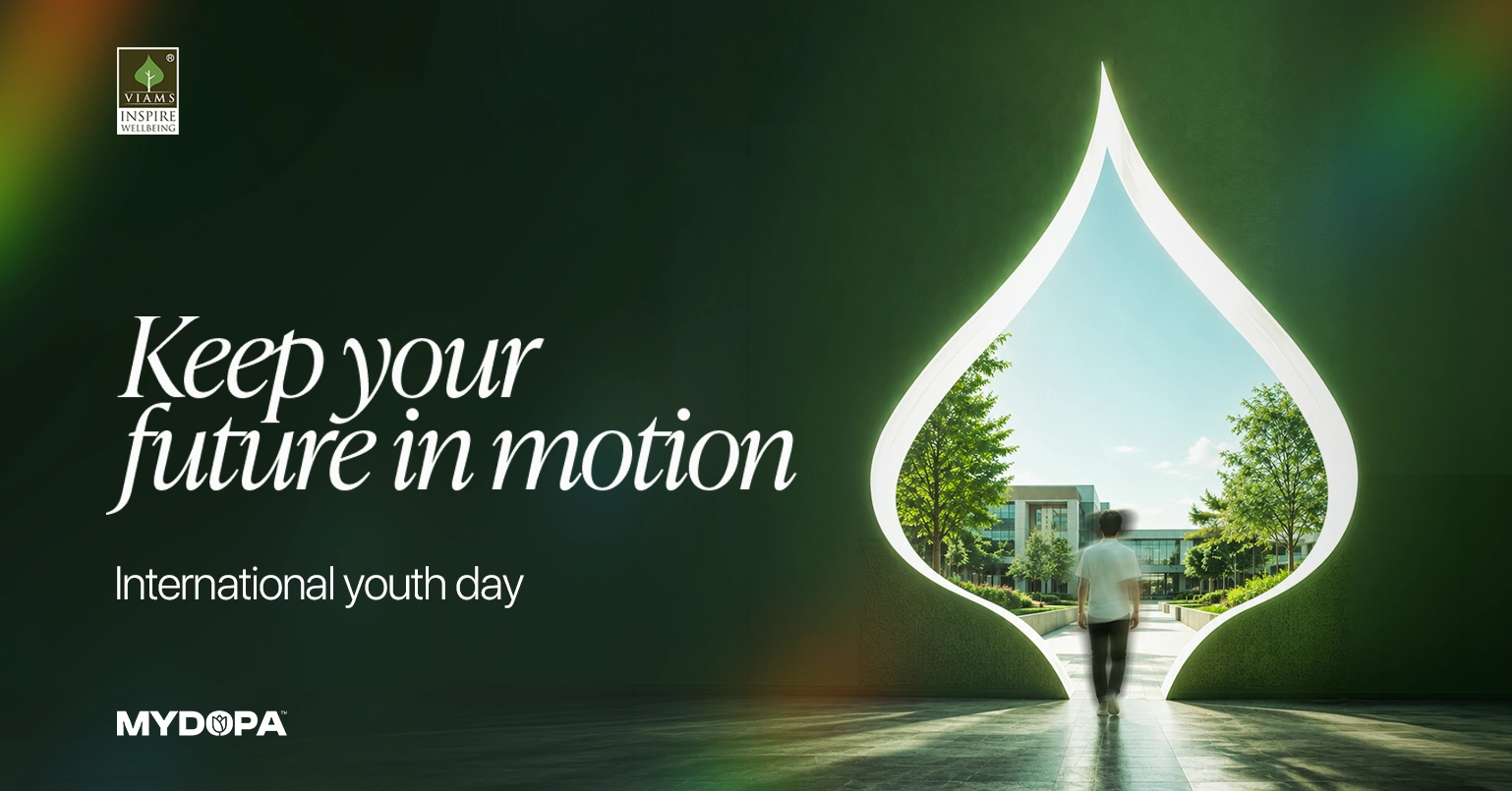
International Youth Day – 12 August 2026
Youth is a time to build, explore, work, dream and move forward.
But what happens when a young person begins experiencing tremor, stiffness, slowed movements, fatigue, changes in sleep, reduced facial expression or difficulties with balance?
For some, these symptoms may be dismissed as stress, lifestyle-related problems or the lingering effects of an earlier illness.
For others, they may represent the early stages of a neurological disorder such as young-onset Parkinson’s disease (YOPD).
This International Youth Day 2026, VIAMS presents a simple message:
International Youth Day is observed every year on 12 August, highlighting the challenges, opportunities and potential of young people around the world.
For young people living with neurological symptoms, keeping the future in motion means more than simply treating a symptom. It means protecting mobility, independence, confidence, participation and quality of life through appropriate medical care, rehabilitation and healthy living.
Parkinson’s disease is commonly associated with older adults. However, young-onset Parkinson’s disease can occur at a much younger age.
A young person may initially notice subtle changes:
Not every one of these symptoms means Parkinson’s disease.
Many neurological and non-neurological conditions can produce similar complaints. That is why early professional assessment is important rather than self-diagnosis.
Young-onset Parkinson’s disease generally refers to Parkinson’s disease diagnosed at a younger age than the typical older-adult presentation.
For a young person, a Parkinson’s diagnosis can create concerns that extend far beyond movement.
There may be questions about:
Career. Education. Marriage. Family. Financial independence. Social life. Physical activity. Long-term health.
This is why YOPD requires a broader approach.
Managing Parkinson’s disease is not simply about reducing tremor.
The larger objective is to help the individual maintain function, independence and quality of life for as long as possible.
The COVID-19 pandemic created enormous interest in the relationship between viral infections and neurological health.
Research has reported neurological manifestations following COVID-19, and isolated reports and small studies have described parkinsonism occurring after SARS-CoV-2 infection. A systematic review and meta-analysis specifically examined reported cases of new-onset parkinsonism following COVID-19.
However, this should be interpreted carefully.
The available evidence does not establish that a person who had COVID-19 will develop Parkinson’s disease later in life.
Research continues to investigate whether infection, inflammation, vascular effects, immune responses and other biological mechanisms could contribute to neurological changes in susceptible individuals.
Therefore, people recovering from COVID-19 should not live in fear of developing Parkinson’s disease.
Instead, the message should be one of awareness and healthy neurological ageing.
If persistent neurological symptoms develop after COVID-19—particularly tremor, stiffness, unusual slowness, balance problems or significant changes in function—appropriate medical evaluation is sensible.
Another important concern arises when a young person has a parent, grandparent, sibling or other relative with Parkinson’s disease.
Family history can increase the likelihood of developing Parkinson’s disease, but having a relative with Parkinson’s does not mean that a person will develop it.
According to the Parkinson’s Foundation, the risk among family members is higher than in people without a relative with Parkinson’s, but the absolute risk remains relatively low for most people. Most people with Parkinson’s do not have an identified genetic variant causing the disease.
This distinction is important.
A young person with a family history can focus on:
The goal is not to constantly look for Parkinson’s disease.
The goal is to build a healthier neurological future.
This is an important message for patients and families.
Lifestyle, exercise, rehabilitation and management of general health can play an important role in maintaining physical and neurological function, but they should not be marketed as a guaranteed method of preventing Parkinson’s disease.
Similarly, Panchakarma should not be presented as a scientifically proven method to prevent Parkinson’s disease.
At VIAMS, Ayurveda-based therapies including Panchakarma may be considered within an individualized integrative-care programme, based on the person’s health status, clinical assessment and therapeutic requirements.
The emphasis should be on supporting overall health, function, wellbeing and healthy ageing, rather than promising prevention.
Parkinson’s disease affects much more than movement.
A person may experience changes involving:
Movement → Speech → Sleep → Digestion → Mood → Cognition → Balance → Activities of daily living → Social participation
Therefore, treatment also needs to look beyond a single symptom.
An integrative Parkinson’s programme can bring together appropriate conventional medical care with supportive rehabilitation approaches.
At VIAMS, the approach may incorporate areas such as:
Understanding the individual’s diagnosis, symptoms, medication requirements and associated medical conditions.
Working on strength, flexibility, posture, balance, gait and functional mobility.
Helping patients maintain independence in everyday activities.
Addressing speech, voice and swallowing-related difficulties when required.
Helping patients and families cope with anxiety, adjustment, motivation and the emotional impact of chronic neurological disease.
When appropriately prescribed, movement-based practices can complement a structured rehabilitation programme.
Ayurveda may be integrated according to individual assessment, with appropriate therapies selected according to the patient’s clinical condition and overall treatment plan.
This is the principle behind integrated neuro-rehabilitation: addressing the person as a whole rather than focusing exclusively on one symptom.
The message of International Youth Day is particularly meaningful for young people living with neurological conditions.
A diagnosis should not automatically mean giving up on education, work, relationships, hobbies or personal ambitions.
The objective should be to identify problems early, establish appropriate treatment and rehabilitation, and continuously adapt care as the person’s needs change.
For a young person with Parkinson’s disease, movement itself becomes part of long-term health management.
Regular physical activity, structured rehabilitation and maintaining functional independence can be important components of Parkinson’s care.
The right programme will depend on the individual’s age, symptoms, disease stage, medical conditions and functional capacity.
You don’t need to wait for a diagnosis to start caring for your neurological health.
Choose regular, enjoyable physical activity appropriate for your health and fitness level.
A symptom that repeatedly affects movement, coordination, sleep or daily activities deserves appropriate evaluation.
Understanding your family’s neurological and medical history can help doctors make better clinical assessments.
Tremor does not automatically mean Parkinson’s disease. Many conditions can cause similar symptoms.
Living with a chronic neurological condition can be emotionally challenging. Psychological support is a legitimate part of comprehensive care.
Parkinson’s management is not a one-time intervention. It is a continuing process involving medical care, rehabilitation, lifestyle management and regular review.
Fact: Parkinson’s is more common with increasing age, but young-onset Parkinson’s disease can occur.
Fact: Family history can increase risk, but Parkinson’s is not inevitably inherited. Most cases do not have a simple genetic inheritance pattern.
Fact: Research is investigating possible associations, and cases of new-onset parkinsonism after COVID-19 have been reported, but causation has not been established.
Fact: Parkinson’s management can include medication, exercise, physiotherapy, occupational therapy, speech therapy, psychological support, lifestyle measures and other individualized interventions.
Fact: Parkinson’s can involve many non-motor symptoms and functional changes. Comprehensive assessment is therefore important.
If you are young and living with Parkinson’s disease, your diagnosis is only one part of your story.
You remain a student.
A professional.
A parent.
A partner.
A friend.
An athlete.
An artist.
An entrepreneur.
A person with goals and dreams.
Good neurological care should therefore look beyond the diagnosis and ask a bigger question:
That is where integrated care and rehabilitation can become meaningful.
Families also need support.
When a young person develops Parkinson’s disease, parents, partners and caregivers may experience uncertainty and anxiety.
The best support is not to do everything for the patient.
It is to help the person remain independent for as long as safely possible. Encourage movement.
Support rehabilitation.
Respect independence.
Listen to concerns.
Attend medical reviews.
Understand medications.
And most importantly, maintain hope without creating unrealistic expectations.
The United Nations observes International Youth Day every year on 12 August, recognizing young people as important contributors to society and development.
For healthcare, the message can be equally powerful:
And for young people affected by neurological disorders:
At VIAMS, our focus is on combining clinical assessment, Ayurveda-based care and multidisciplinary rehabilitation to support people living with Parkinson’s disease and other neurological conditions.
The objective is not simply to ask, “How do we treat the disease?”
It is also to ask:
Because the future is not only about how long we live.
It is also about how well we are able to live, move, participate and remain independent.
Keep Your Future in Motion.
Yes. Although Parkinson’s disease is more common with increasing age, young-onset Parkinson’s disease can occur. Persistent movement-related symptoms should be evaluated by an appropriately qualified healthcare professional.
No. Family history can increase risk, but it does not mean that a person will definitely develop Parkinson’s disease. Most Parkinson’s cases are not caused by a single inherited genetic mutation.
Current evidence does not establish COVID-19 as a proven cause of Parkinson’s disease. Research has reported cases of new-onset parkinsonism after COVID-19, but more evidence is required to understand whether there is a causal relationship.
Routine Parkinson’s screening for every person who has had COVID-19 is not currently established as standard care. However, persistent or progressive neurological symptoms should be medically assessed.
There is currently no established scientific evidence that Panchakarma can guarantee prevention of Parkinson’s disease. Within an appropriately supervised integrative-care programme, Ayurveda-based therapies may be considered for selected individuals according to their health status and therapeutic needs.
Exercise and rehabilitation are important components of comprehensive Parkinson’s management and can help maintain mobility, physical function and quality of life. The type and intensity should be individualized.
If tremor, stiffness, slowness, balance problems, changes in handwriting, gait changes or other neurological symptoms persist or progressively interfere with daily life, professional evaluation is appropriate.
For young people affected by COVID-19, individuals with a family history of Parkinson’s disease, people living with young-onset Parkinson’s disease and their caregivers, awareness can be the first step toward better long-term care.
There is no need for fear.
At VIAMS, we believe that neurological care should be comprehensive, compassionate and focused on the whole person.
If you or someone in your family is experiencing persistent neurological symptoms or living with Parkinson’s disease, you can speak with the VIAMS team for appropriate guidance and to understand whether an integrated care and rehabilitation approach may be suitable.
Keep your future in motion.
Need expert guidance? Connect with VIAMS to get personalized support for your medical career journey.