
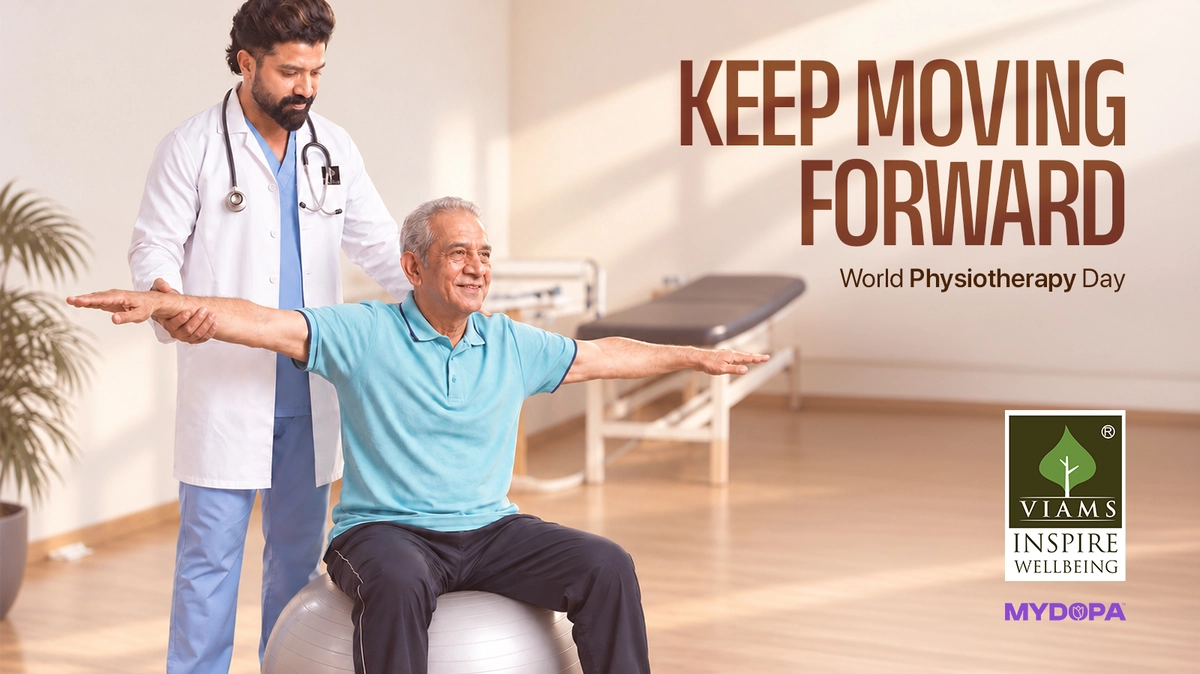
Watching a parent’s hands tremble, their walk slow down, or their voice grow softer is one of the hardest things a son or daughter can go through. Parkinson’s disease changes daily life gradually, and families often feel unsure about what will really help — medicines alone, physiotherapy alone, or something more.
This World Physiotherapy Day 2026, observed globally on 8 September, is a good moment to look beyond a single-treatment mindset. Growing clinical experience, including work being done at Ayurveda-based centres such as VIAMS in Kerala, shows that combining Ayurveda therapies, Panchakarma, and physiotherapy can offer real, measurable improvements in mobility, confidence, and quality of life for people living with Parkinson’s — even though the condition has no permanent cure.
This article explains why an integrative approach matters, what each part of the treatment does, and how families can make informed decisions for a parent living with Parkinson’s.
World Physiotherapy Day is marked every year on 8 September to recognise the role physiotherapists play in helping people move, recover, and stay independent. It was founded in 1951 and has been observed globally since 1996.
Each year, World Physiotherapy (the global body representing the profession) chooses a health theme. For 2026, the global focus is on cardiovascular disease and stroke rehabilitation — a reminder of how central movement-based therapy is to managing long-term conditions, not just injuries.
Neurological conditions like Parkinson’s disease sit in the same broad family of concerns: they are progressive, they affect movement and independence, and they respond well to consistent, structured rehabilitation. That is exactly where physiotherapy — supported by Ayurveda and Panchakarma — plays its most meaningful role.
Parkinson’s disease is a progressive neurological condition. It affects the brain’s ability to coordinate smooth, controlled movement. Common signs include:
Modern medicine manages Parkinson’s mainly through medication that supports dopamine levels in the brain. This helps control symptoms, but many families notice that over time, medication alone isn’t enough — some difficulties in walking, balance, stiffness, and daily function tend to remain or slowly return.
In Ayurveda, Parkinson’s-like symptoms are described under the umbrella of Kampavata, a condition rooted in an aggravated Vata dosha — the biological force in the body responsible for all movement, including nerve conduction and muscle coordination. This is why Ayurveda’s approach focuses heavily on calming and stabilising Vata through internal medicines, external therapies, and lifestyle correction.
Physiotherapy is one of the most well-supported non-drug interventions for Parkinson’s disease worldwide. A trained physiotherapist works on:
Regular physiotherapy does not slow the underlying nerve degeneration, but it meaningfully slows the functional decline — meaning a person can often keep doing more, for longer, safely.
Ayurveda approaches Parkinson’s from a different angle: correcting the internal imbalance that is believed to drive the disturbance in movement and coordination, alongside supporting the nervous system directly.
Panchakarma, Ayurveda’s structured detoxification and rejuvenation protocol, includes therapies commonly used in Parkinson’s management, such as:
These are typically combined with internal Ayurvedic medicines, many of which are being studied for their neuroprotective and dopamine-supportive properties, along with personalised diet and daily routine (dinacharya) guidance.
This is the central idea families need to understand: Parkinson’s is a multi-system condition, and no single therapy addresses all of it.
| Approach | Primary Strength | Limitation Alone |
|---|---|---|
| Medication | Controls core symptoms | Doesn’t halt functional decline |
| Physiotherapy | Rebuilds movement, balance, strength | Doesn’t address internal nervous system balance |
| Ayurveda & Panchakarma | Calms Vata, supports nerve and muscle tissue, manages non-motor symptoms | Works best with structured movement therapy, not instead of it |
When physiotherapy and Ayurveda therapies are planned together — rather than one after the other in isolation — the body seems to respond more consistently. Panchakarma therapies relax rigid muscles and calm the nervous system, which often makes physiotherapy sessions more effective and less painful. Physiotherapy, in turn, helps the body retain and use the improved flexibility and strength that Ayurveda therapies create.
This integrative model is the philosophy behind the work done at centres like VIAMS, where Ayurveda-based neurological care is combined with structured rehabilitation rather than offered as a standalone “alternative.”
Myth: “Ayurveda can cure Parkinson’s completely.” Truth: No current treatment — Ayurvedic or modern — offers a permanent cure. The honest and realistic goal is to slow progression, manage symptoms, and preserve independence for as long as possible.
Myth: “Once on Ayurveda, medication should be stopped.” Truth: Ayurveda and conventional medication are not meant to compete. Any changes to medication should only be made in consultation with the treating neurologist.
Mistake: Starting therapy only after symptoms become severe. Truth: Both physiotherapy and Ayurveda work best when started early, soon after diagnosis, rather than being seen as a “last resort.”
Mistake: Inconsistent therapy. Truth: Parkinson’s care, of any kind, needs consistency. Occasional sessions rarely produce noticeable, lasting benefit.
If your parent has been diagnosed with Parkinson’s disease, here are a few practical steps:
1.Can Ayurveda and Panchakarma cure Parkinson’s disease?
No treatment currently cures Parkinson’s disease. Ayurveda and Panchakarma aim to manage symptoms, slow functional decline, and improve quality of life alongside standard medical care.
2.Is it safe to combine Ayurveda treatment with allopathic Parkinson’s medication?
Generally yes, when supervised by qualified professionals on both sides. Never stop or reduce prescribed medication without your neurologist’s guidance.
3.How soon can families expect to see improvement?
Most integrative programmes are designed as multi-week protocols, with visible changes in stiffness, movement ease, or sleep typically noticed over several weeks of consistent therapy, not days.
4.Is Panchakarma safe for elderly parents with Parkinson’s?
Panchakarma therapies for Parkinson’s are usually modified in intensity and duration for elderly or more advanced patients, and should always be done under medical supervision at a qualified centre.
5.What is the ideal age or stage to start integrative Parkinson’s care?
Earlier is better. Starting soon after diagnosis, while mobility and strength are still relatively preserved, tends to give the best long-term functional outcomes.
6.Does physiotherapy alone help without Ayurveda?
Physiotherapy alone does help and is an essential part of Parkinson’s management worldwide. Combining it with Ayurveda and Panchakarma is aimed at addressing symptoms and comfort that physiotherapy alone may not fully cover, such as rigidity, sleep, and internal imbalance.
7.How do I choose the right centre for integrative Parkinson’s care?
Look for a centre with qualified Ayurveda physicians experienced specifically in neurodegenerative conditions, willingness to coordinate with your parent’s neurologist, and a track record of structured, monitored treatment protocols rather than one-off therapies.
Parkinson’s disease is a long journey, for the patient and the family. This World Physiotherapy Day 2026, the most important message for sons, daughters, and caregivers of parents with Parkinson’s disease is simple: you don’t have to choose between physiotherapy and Ayurveda. Used together, thoughtfully and consistently, they address the condition from more than one direction — movement, muscle, nervous system, and daily function — giving parents a better chance at staying mobile, confident, and independent for longer.
Need expert guidance? Connect with VIAMS to get personalized support for your medical career journey.